Advanced Topics · GUIDE

Common Deal Structures: SAFEs, Convertible Notes, and Priced Rounds Compared

SAFEs, convertible notes, and priced rounds each handle your ownership.

8 min read

Updated May 29th, 2026
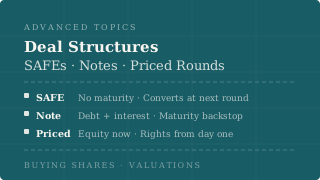
Deal Structures slide explaining SAFE, Notes, and Priced Rounds with key characteristics.

When you invest in a private company, you’re not just buying a stake — you’re signing a contract that determines when you become a shareholder, at what price, and what standing you have if the company never raises again. Three instruments dominate early-stage private deals: SAFEs, convertible notes, and priced equity rounds. Knowing what you’re holding changes how you read everything else.

The Question Behind the Question

Before comparing instruments, there’s one foundational question worth sitting with: when does your investment become equity?

In a priced round, the answer is the moment the round closes. You invest, shares are issued, and your ownership percentage is set. With a SAFE or convertible note, you hand over capital now and receive shares later — at a future event, usually a new funding round. Until that conversion happens, you’re an investor but not yet a shareholder of record.

That distinction is not a technicality. It affects your rights, your standing in a sale, and what happens if the company winds down before ever raising again.

SAFEs: Simple Agreements for Future Equity

A SAFE is a one-way bet on the company’s future. You invest a fixed amount today; in return, the company promises to issue you shares when it raises a qualifying priced round — at a price more favorable than what that round’s investors will pay.

SAFEs have no interest rate. No maturity date. No repayment obligation. If the company never raises a qualifying round, your SAFE may never convert, and depending on the document’s terms, you may have limited recourse.

Two terms control how favorable your conversion price will be:

Valuation cap sets a ceiling on the price at which your SAFE converts, regardless of how high the next round’s valuation goes. A $5M cap on a company that raises its Series A at $15M means you convert as if the company were worth $5M — giving you significantly more shares for the same dollars as the new investors.

Discount rate lets you convert at a fixed percentage below whatever the next round pays. A 20% discount means you pay $0.80 for every dollar of share price that Series A investors pay.

Most SAFEs carry one or both. When both apply, whichever produces the better price for you typically governs. The majority of SAFEs issued today are post-money SAFEs — the cap is calculated after your investment is included, which makes ownership math more predictable for everyone.

One term worth hunting for: a most-favored-nation (MFN) clause. If the company later issues a SAFE with better terms than yours, an MFN provision automatically updates your SAFE to match. It’s not universal, but it’s worth asking about.

Convertible Notes: Debt Designed to Become Equity

A convertible note is a loan with an unusual exit ramp: instead of being repaid in cash, it’s designed to convert into equity at the next funding round. Like any loan, it carries an interest rate (typically 4–8% annually) and a maturity date — usually 18 to 24 months — by which conversion is expected to have happened.

Convertible notes use the same cap and discount mechanics as SAFEs. The structural differences come down to three things:

The maturity date creates leverage. If the company reaches maturity without a qualifying round, it must repay the principal and accrued interest — or negotiate with noteholders to extend. That obligation gives you a position that SAFE holders don’t have if things stall.

Interest accrues in your favor. The principal that converts isn’t just what you invested — it’s your original check plus interest. Over 18–24 months at 5–6%, that’s a modest but real difference in the share count you receive.

Debt ranks above equity in liquidation. In a worst-case wind-down, noteholders have a claim on company assets before shareholders do. SAFEs, depending on their terms, often sit alongside or below common equity.

Convertible notes preceded SAFEs and remain common, especially in bridge rounds — small raises between larger priced rounds — where the company needs capital quickly and wants to defer valuation negotiations. Investors who prefer the maturity date protection, or who are simply more comfortable with debt instruments, still reach for notes.

Priced Rounds: Equity Now, Terms Set Today

In a priced round, the company and its investors agree on a valuation, shares are issued at a price per share that reflects that valuation, and you become a shareholder of record the moment the round closes. No future conversion event. No uncertainty about your ownership percentage. You know what you own.

Priced rounds are more complex and expensive to execute — they require a full term sheet, a certificate of incorporation amendment to authorize a new share class, and a stock purchase agreement. That overhead is why early-stage companies often use SAFEs or notes instead. By Series A, most rounds are priced.

The investor-facing advantage is immediate, defined rights. The share class you receive — almost always preferred stock in institutional rounds — carries explicit terms: liquidation preference, anti-dilution protection, information rights, and sometimes pro-rata rights for future rounds. As covered in the , those terms vary and are worth reading in the actual documents, not just the summary.

Liquidation preference is especially worth understanding. Preferred shareholders get their investment back — and sometimes a multiple of it — before common shareholders participate in proceeds from a sale or dissolution. In a priced round, you’ll know exactly what your preference is at the time you invest.

How the Three Compare

No instrument is inherently better. SAFEs are fast and founder-friendly. Notes give investors a maturity backstop. Priced rounds give investors immediate equity with defined rights. The right one depends on the company’s stage, the deal terms, and what you’re willing to accept in exchange for access.

What the Documents Actually Say

The instrument type tells you the shape of the deal. The specific terms tell you the economics. Before investing in any of the three, locate answers to these:

  • What is the valuation cap, and is it pre-money or post-money?
  • Is there a discount rate, and which applies if both are present?
  • For SAFEs and notes: what happens in a sale or dissolution before conversion?
  • For convertible notes: what happens at maturity if no qualifying round has closed?
  • For priced rounds: what are the liquidation preference terms — 1x non-participating, 1x participating, or something else?
  • Is there an MFN clause? A pro-rata right for future rounds?

For Reg CF and Reg A+ offerings, the Form C or offering circular filed with the SEC will specify the instrument type and its material terms. That filing — not the campaign page — is the document that governs. The is useful background for understanding the regulatory framework around the deal.

The Thing Worth Remembering

Knowing your instrument doesn’t tell you whether a company is worth backing. It tells you what you’ll own if things go well, what standing you have if they don’t, and when you’ll find out your actual ownership percentage. All three of those matter. Read what you’re signing.

This article is for educational purposes only and does not constitute investment, legal, or financial advice. Private market investing involves significant risk, including the potential loss of your entire investment. Consult a qualified financial or legal advisor before making investment decisions.

Important disclosure

All content is for educational purposes only and does not constitute investment advice. All investments involve risk, including loss of principal. Please consult with a qualified financial advisor before making investment decisions.

Important Message

IN MAKING AN INVESTMENT DECISION, INVESTORS MUST RELY ON THEIR OWN EXAMINATION OF THE ISSUER AND THE TERMS OF THE OFFERING, INCLUDING THE MERITS AND RISKS INVOLVED. INVESTMENTS ON STARTENGINE ARE SPECULATIVE, ILLIQUID, AND INVOLVE A HIGH DEGREE OF RISK, INCLUDING THE POSSIBLE LOSS OF YOUR ENTIRE INVESTMENT.

www.StartEngine.com is a website owned and operated by StartEngine Crowdfunding, Inc. (“StartEngine”), which is neither a registered broker-dealer, investment advisor nor funding portal.

Unless indicated otherwise with respect to a particular issuer, all securities-related activity is conducted by regulated affiliates of StartEngine: StartEngine Capital LLC, a funding portal registered here with the US Securities and Exchange Commission (SEC) and here as a member of the Financial Industry Regulatory Authority (FINRA), or StartEngine Primary LLC (“SE Primary”), a broker-dealer registered with the SEC and FINRA / SIPC. You can review the background of our broker-dealer and our investment professionals on FINRA’s BrokerCheck here. StartEngine Secondary is an alternative trading system (ATS) regulated by the SEC and operated by SE Primary. SE Primary is a member of SIPC and explanatory brochures are available upon request by contacting SIPC at (202) 371-8300.

StartEngine facilitates three types of primary offerings:

1) Regulation A offerings (JOBS Act Title IV; known as Regulation A+), which are offered to non-accredited and accredited investors alike. These offerings are made through StartEngine Primary, LLC (unless otherwise indicated). 2) Regulation D offerings (Rule 506(c)), which are offered only to accredited investors. These offerings are made through StartEngine Primary, LLC. 3) Regulation Crowdfunding offerings (JOBS Act Title III), which are offered to non-accredited and accredited investors alike. These offerings are made through StartEngine Capital, LLC. Some of these offerings are open to the general public, however there are important differences and risks.

Any securities offered on this website have not been recommended or approved by any federal or state securities commission or regulatory authority. StartEngine and its affiliates do not provide any investment advice or recommendation and do not provide any legal or tax advice concerning any securities. All securities listed on this site are being offered by, and all information included on this site is the responsibility of, the applicable issuer of such securities. StartEngine does not verify the adequacy, accuracy, or completeness of any information. Neither StartEngine nor any of its officers, directors, agents, and employees makes any warranty, express or implied, of any kind whatsoever related to the adequacy, accuracy, or completeness of any information on this site or the use of information on this site.

Investing in private company securities is not suitable for all investors. An investment in private company securities is highly speculative and involves a high degree of risk. It should only be considered a long-term investment. You must be prepared to withstand a total loss of your investment. Private company securities are also highly illiquid, and there is no guarantee that a market will develop for such securities. Each investment also carries its own specific risks, and you should complete your own independent due diligence regarding the investment. This includes obtaining additional information about the company, opinions, financial projections, and legal or other investment advice. Accordingly, investing in private company securities is appropriate only for those investors who can tolerate a high degree of risk and do not require a liquid investment. See additional general disclosures here.

By accessing this site and any pages on this site, you agree to be bound by our Terms of use and Privacy Policy, as may be amended from time to time without notice or liability.

Canadian Investors

Investment opportunities posted and accessible through the site will not be offered to Canadian resident investors. Potential investors are strongly advised to consult their legal, tax and financial advisors before investing. The securities offered on this site are not offered in jurisdictions where public solicitation for offerings is not permitted; it is solely your responsibility to comply with the laws and regulations of your country of residence.

California Investors Only – Do Not Sell My Personal Information (800-317-2200). StartEngine does not sell personal information. For all customer inquiries, please write to contact@startengine.com.

StartEngine Marketplace (“SE Marketplace”) is a website operated by StartEngine Primary, LLC (“SE Primary”), a broker-dealer that is registered with the SEC and a member of FINRA and the SIPC.

StartEngine Secondary (“SE Secondary”) is our investor trading platform. SE Secondary is an SEC-registered Alternative Trading System (“ATS”) operated by SE Primary that matches orders for buyers and sellers of securities. It allows investors to trade shares purchased through Regulation A+, Regulation Crowdfunding, or Regulation D for companies who have engaged StartEngine Secure LLC as their transfer agent. The term “Rapid,” when used in relation to transactions on SE Marketplace, specifically refers to transactions that are facilitated on SE Secondary, This is because, unlike with trades on the StartEngine Bulletin Board (“SE BB”), trades on SE Secondary are executed the moment that they are matched.

StartEngine Bulletin Board (“SE BB”) is a bulletin board platform on which users can indicate to each other their interest to buy or sell shares of private companies that previously executed Reg CF or Reg A offerings not necessarily through SE Primary. As a bulletin board platform, SE BB provides a venue for investors to access information about such private company offerings and connect with potential sellers. All investment opportunities on SE BB are based on indicated interest from sellers and will need to be confirmed. Even if parties express mutual interest to enter into a trade on SE BB, a trade will not immediately result because execution is subject to additional contingencies, including among others, effecting of the transfer of the shares from the potential seller to the potential buyer by the issuer and/or transfer agent. SE BB is distinct and separate from SE Secondary. SE Secondary facilitates the trading of securities by matching orders between buyers and sellers and facilitating executions of trades on the platform. By contrast, under SE BB, SE Primary assists with the facilitation of a potential resulting trade off platform including, by among other things, approaching the issuer and other necessary parties in relation to the potential transaction. The term “Extended”, when used in relation to transactions on SE Marketplace denotes that these transactions are conducted via SE BB, and that these transactions may involve longer processing times compared to SE Secondary for the above-stated reasons.

Even if a security is qualified to be displayed on SE Marketplace, there is no guarantee an active trading market for the securities will ever develop, or if developed, be maintained. You should assume that you may not be able to liquidate your investment for some time or be able to pledge these shares as collateral.

The availability of company information does not indicate that the company has endorsed, supports, or otherwise participates with StartEngine. It also does not constitute an endorsement, solicitation or recommendation by StartEngine. StartEngine does not (1) make any recommendations or otherwise advise on the merits or advisability of a particular investment or transaction, (2) assist in the determination of the fair value of any security or investment, or (3) provide legal, tax, or transactional advisory services.