Advanced Topics · PRACTITIONER GUIDE
Shareholder Rights in Private Companies: What You Can (and Can't) Expect
What private shareholders actually get — and what to ask before you commit.
6 min read
Updated May 29th, 2026
When you buy shares in a public company, a thick body of securities law backs you up. You get quarterly filings, audited financials, a shareholder vote on major decisions, and a liquid market to exit if you change your mind. Private companies offer none of those guarantees by default — and as an accredited investor putting real capital into illiquid positions, it pays to know exactly where you stand before you wire a dollar.
This isn't a reason to avoid private investing. It is a reason to read the documents carefully, ask direct questions, and understand the difference between rights you negotiated and rights you assumed you had.
What "Minority Shareholder" Really Means
Most accredited investors enter private deals as minority shareholders — meaning they own a small percentage of the company with no practical ability to influence day-to-day decisions, force a sale, or compel management to return capital. This is structurally normal. Early-stage companies need to move fast, and founders reasonably resist giving veto power to dozens of individual investors.
But minority status has real consequences. If the company raises a new round at a lower valuation, your stake can be diluted. If management decides to pay themselves generous salaries before distributing proceeds, you may have limited recourse. If the company sells for less than the liquidation preference stack held by preferred shareholders above you, common shareholders — which is often what crowdfunding investors hold — may receive little or nothing.
Understanding your rights isn't pessimism. It's how you evaluate whether the terms of a deal match the risk you're being asked to take on.
Rights That Exist in Well-Structured Private Deals
The rights available to private investors vary significantly by deal type, offering structure, and how much leverage the investor brought to the negotiation. Institutional lead investors in a $10M Series A will typically secure more protections than an individual investor writing a $25,000 check into a Reg CF offering. That said, here are the rights worth knowing about — and worth asking about.
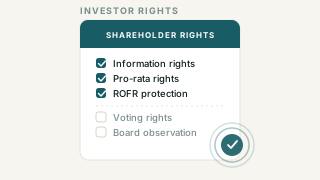
Information rights give you access to the company's financial statements, typically annually and sometimes quarterly. In more investor-friendly deals, these are formalized in the investment agreement. In others, you may only receive updates if and when the company chooses to send them.
Voting rights allow shareholders to weigh in on major corporate decisions — electing board members, approving mergers, authorizing new share classes. Not all private shares carry equal voting weight. Some companies issue non-voting or limited-voting shares to outside investors while founders retain supervoting shares.
Pro-rata rights give you the option to participate in future funding rounds in proportion to your current ownership, allowing you to maintain your percentage stake rather than being diluted by new investors. These are typically negotiated by larger check writers and are uncommon in retail crowdfunding deals.
Right of first refusal (ROFR) means that if another shareholder wants to sell their shares, the company (or other shareholders) gets the first opportunity to buy them before an outside party can. This protects against unwanted third parties entering the cap table.
Anti-dilution protection adjusts your conversion price (or effective ownership) if the company later raises money at a lower valuation than when you invested — a "down round." Not all investors receive this; when it is granted, the specific flavor (broad-based weighted average vs. full ratchet) matters a great deal.
Board observation rights allow an investor to attend board meetings without voting. These are typically reserved for investors writing six-figure checks and are rarely extended to crowdfunding participants.
Inspection rights let you review the company's books and records upon request. These are more commonly available under state corporate law than explicitly granted in investment agreements, but their practical enforceability varies.
How Investor Rights Vary in Reg D and Reg CF Deals
Investor rights in private offerings vary significantly by deal — and that variation is the most important thing to understand before you commit capital.
Some of the rights described above are widely available; others are negotiated only by lead investors writing large checks. A company running a Reg CF campaign may have hundreds or thousands of individual investors. Granting each one full information rights with audited financials, pro-rata participation in every future round, or board observation seats would be operationally complex and, in many cases, structurally unworkable. As a result, the rights extended to retail accredited investors in equity crowdfunding usually look different from what a Series A lead negotiates with the same company.
The specifics vary by platform, by offering structure, and by the company's own choices about what to include in its investor terms. Some offerings include standardized information rights for all participants. Others provide only what securities law requires. Some grant pro-rata rights to investors above a check-size threshold. Most do not.
What's typically required by law for retail investors in Reg CF and Reg A+ offerings:
- An annual report filed with the SEC
- Notification of major corporate events as defined in the offering terms
- Voting rights as specified in the company's governing documents — though the practical influence of any individual investor's vote depends on share class structure and ownership percentage
What may or may not be included, depending on the specific offering:
- Information rights beyond the SEC minimum
- Pro-rata participation in future rounds
- Anti-dilution protection
- Inspection rights beyond what state corporate law provides
- Drag-along and tag-along provisions
The question isn't whether you have the same protections as a Series A lead — you typically don't, and the economics of raising capital from many small investors at once make that structurally normal. The question is what specific rights are spelled out in your offering, whether those rights are proportionate to the return potential being offered, and whether you've actually read the documents that govern them.
The Gap Between Term Sheets and Final Documents
One of the most common surprises for less experienced private investors is discovering that what was described in a pitch deck or offering summary isn't quite what's in the actual governing documents.
Term sheets are non-binding summaries. The rights that actually govern your investment are in the stockholder agreement, the certificate of incorporation, the operating agreement (for LLCs), the subscription agreement, or some combination of all of them. These documents can run dozens of pages and are written in legal language — but they are the documents that control what happens if things go sideways.
A few things that are worth checking in the actual documents, not the summary materials:
- Which share class are you receiving, and what are its specific economic and voting terms?
- Are information rights contractually guaranteed, or does the company retain discretion?
- What triggers your anti-dilution protection, if any, and which form applies?
- Are there drag-along provisions that could force you to sell if a majority of shareholders approve a transaction you'd reject?
- What happens to your shares in an acquisition? Is there a minimum return threshold before common shareholders participate?
If these questions feel complicated, that's the point. You don't need to negotiate them — but you should understand the answers before you invest.
Questions to Ask Before You Commit
You may not get answers to all of these, and some are more relevant to larger Reg D deals than to crowdfunding offerings. But asking them tells you something either way.
- What class of shares am I receiving, and what are the voting and economic terms?
- Does this share class carry information rights? What exactly will I receive, and how often?
- Do I have any anti-dilution protection? If so, what type?
- Is there a pro-rata right to participate in future rounds?
- Who controls the board, and do I have any mechanism to influence board composition?
- Are there drag-along provisions that could force a sale without my consent?
- In a liquidation or acquisition, at what point does my share class participate in proceeds?
- Where can I find the actual stockholder agreement, operating agreement, or certificate of incorporation — not just the summary?
For Reg CF and Reg A+ offerings, many of these terms are disclosed in the Form C or offering circular filed with the SEC. Reading those documents, or at least the sections covering share class and investor rights, is always time well spent.
What This Means for How You Evaluate Deals
Limited rights aren't disqualifying. Many successful private investments are structured with thin investor protections, and the returns still justified the risk. What matters is that you're evaluating deals with an accurate picture of where you stand — not an optimistic one.
A company that offers clean disclosures, files updates consistently, and treats minority shareholders as partners worth communicating with is behaving well regardless of what's technically contractual. A company that is evasive about its share class structure or dismisses questions about governing documents deserves more scrutiny, not less.
Your rights as a private investor are often narrower than you'd have in a public market. That's the deal. The upside potential of early-stage private investing reflects that reality. Going in with clear eyes about both is what separates investors who get surprised from investors who don't.
This article is for educational purposes only and does not constitute investment, legal, or financial advice. Private market investing involves significant risk, including the potential loss of your entire investment. Consult a qualified financial or legal advisor before making investment decisions.
Important disclosure
All content is for educational purposes only and does not constitute investment advice. All investments involve risk, including loss of principal. Please consult with a qualified financial advisor before making investment decisions.

