Fundamentals · WALKTHROUGH

What Is an Accredited Investor — and What Can You Actually Do With That Status?

Reg D, Reg A+, private funds, and secondary markets — what accredited status actually unlocks.

9 min read

Updated May 29th, 2026

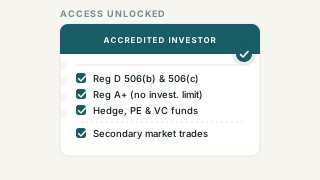
Accredited investor access unlocked, detailing Reg D, Reg A+, investment funds, and market trades.

If you've confirmed you qualify as an accredited investor, you've cleared a threshold that gives you access to a category of investments most people never see. But clearing the threshold and knowing what to do with it are two different things.

The existing article on accredited vs. non-accredited investors covers the qualification criteria in detail — income thresholds, net worth tests, the professional knowledge pathway added in 2020. This article picks up where that one leaves off. Now that you qualify, here's what's actually available to you, how the deals are structured, and what "access" realistically means in practice.

The Core Benefit: You Can Invest in Unregistered Securities

Most investments available to the general public have been registered with the SEC. Registration is expensive, time-consuming, and requires ongoing disclosure obligations. Many companies — particularly early-stage startups — aren't willing or able to meet that bar. So they raise capital under exemptions from registration, and most of those exemptions require that investors be accredited.

When you're accredited, you can invest in these exempt offerings. That means you can get into companies before they're public, at valuations that wouldn't be available on a stock exchange, and often at stages where the growth potential is highest. It also means the disclosures you receive are lighter than what public markets require, the investments are illiquid, and the risk profile is fundamentally different. Access cuts both ways.

Rule 506(b) and 506(c): Two Flavors of Reg D

The most common exemption you'll encounter as an accredited investor is Regulation D, specifically its two main rules: 506(b) and 506(c). Understanding the difference matters because it affects how companies can approach you — and how you can approach them.

Rule 506(b) is the traditional path. Companies can raise an unlimited amount of capital, and up to 35 non-accredited (but "sophisticated") investors can participate alongside accredited ones. The catch: companies cannot publicly advertise the offering. They can only approach investors with whom they have a pre-existing relationship. If you've been introduced to a deal through a mutual contact, a syndicate, or a platform you already belong to, it's likely structured under 506(b).

Rule 506(c) was created by the JOBS Act in 2012 and allows companies to openly advertise their offerings — on social media, in emails to strangers, on investment platforms. The trade-off is that only accredited investors can participate, and the company must take "reasonable steps" to verify that accreditation. In practice, this means you may be asked to submit tax returns, brokerage statements, or a letter from a licensed professional confirming your status.

Most of the private deals you'll find on equity crowdfunding platforms and syndication networks are structured under one of these two rules. Knowing which one governs a specific offering helps you understand why you're being asked for certain documentation and what kind of outreach is permissible.

What Reg D Deals Actually Look Like

Reg D is not a single type of investment — it's a legal framework that covers a wide range of deal structures and company stages. Under that umbrella, you might encounter:

  • Angel rounds and seed deals — early bets on pre-revenue companies, typically ranging from $500K to $3M raised, often structured as SAFEs or convertible notes
  • Series A and later priced rounds — more established companies raising $5M or more against a formal valuation, typically structured as preferred equity
  • Real estate syndications — pooled investments into commercial or residential properties, where accredited status is required to participate
  • Private funds and SPVs — venture funds, search funds, and special purpose vehicles that aggregate investor capital into a single investment thesis

Minimum check sizes vary widely. Some Reg D deals accept $5,000; others require $25,000, $50,000, or more. There is no universal floor set by the SEC — minimums are set by the company or fund manager, and they tend to reflect the operational cost of managing a large number of small investors.

Beyond Reg D: Other Doors Your Status Opens

Reg D is the most common pathway, but accredited status also expands your access in a few other directions worth knowing about.

Reg A+ Tier 2 offerings are open to non-accredited investors, but as an accredited investor you face no investment limits — non-accredited investors are capped at 10% of their annual income or net worth per offering. If a company you want to back is running a Reg A+ raise, your accredited status removes that ceiling.

Hedge funds, private equity funds, and venture funds typically require both accredited status and, in many cases, a higher "qualified purchaser" designation (generally $5M in investments). Accreditation is a floor for these vehicles, not always a sufficient credential on its own — but it's a necessary one.

Secondary market transactions in private shares are frequently limited to accredited investors, both by platform policy and by transfer restrictions in the original investment documents. If you want to buy shares in a private company from an existing shareholder rather than directly from the company, accreditation typically determines whether you can participate.

Verification: What to Expect

Because 506(c) offerings require active verification, and because some platforms require it regardless of offering type, you should be prepared to document your accredited status. Common methods include:

  • Providing your two most recent tax returns showing income above the threshold
  • Submitting a brokerage or bank statement showing net worth (excluding your primary residence) above $1 million
  • Obtaining a written confirmation from a registered broker-dealer, licensed attorney, CPA, or registered investment adviser

Some platforms maintain verification on file for 90-day periods; others require fresh documentation per transaction. It's worth keeping these documents accessible if you're actively investing.

What Accredited Status Doesn't Do

Access is not an edge. Being allowed into a deal is different from that deal being a good investment. Private markets include companies at every quality level, run by founders with widely varying competence and integrity, raising at valuations that range from disciplined to detached from reality.

Accredited investor rules exist to ensure participants can bear the financial risk of loss, not to curate deals worth taking. The due diligence, the judgment about team and market, the read on valuation — those remain entirely your responsibility. The SEC isn't vouching for any company that files under Reg D. Neither is the platform that lists it.

Your accredited status is a key. What's behind each door still requires careful evaluation before you walk through it.

This article is for educational purposes only and does not constitute investment, legal, or financial advice. Private market investing involves significant risk, including the potential loss of your entire investment. Consult a qualified financial or legal advisor before making investment decisions.

Important disclosure

All content is for educational purposes only and does not constitute investment advice. All investments involve risk, including loss of principal. Please consult with a qualified financial advisor before making investment decisions.

Important Message

IN MAKING AN INVESTMENT DECISION, INVESTORS MUST RELY ON THEIR OWN EXAMINATION OF THE ISSUER AND THE TERMS OF THE OFFERING, INCLUDING THE MERITS AND RISKS INVOLVED. INVESTMENTS ON STARTENGINE ARE SPECULATIVE, ILLIQUID, AND INVOLVE A HIGH DEGREE OF RISK, INCLUDING THE POSSIBLE LOSS OF YOUR ENTIRE INVESTMENT.

www.StartEngine.com is a website owned and operated by StartEngine Crowdfunding, Inc. (“StartEngine”), which is neither a registered broker-dealer, investment advisor nor funding portal.

Unless indicated otherwise with respect to a particular issuer, all securities-related activity is conducted by regulated affiliates of StartEngine: StartEngine Capital LLC, a funding portal registered here with the US Securities and Exchange Commission (SEC) and here as a member of the Financial Industry Regulatory Authority (FINRA), or StartEngine Primary LLC (“SE Primary”), a broker-dealer registered with the SEC and FINRA / SIPC. You can review the background of our broker-dealer and our investment professionals on FINRA’s BrokerCheck here. StartEngine Secondary is an alternative trading system (ATS) regulated by the SEC and operated by SE Primary. SE Primary is a member of SIPC and explanatory brochures are available upon request by contacting SIPC at (202) 371-8300.

StartEngine facilitates three types of primary offerings:

1) Regulation A offerings (JOBS Act Title IV; known as Regulation A+), which are offered to non-accredited and accredited investors alike. These offerings are made through StartEngine Primary, LLC (unless otherwise indicated). 2) Regulation D offerings (Rule 506(c)), which are offered only to accredited investors. These offerings are made through StartEngine Primary, LLC. 3) Regulation Crowdfunding offerings (JOBS Act Title III), which are offered to non-accredited and accredited investors alike. These offerings are made through StartEngine Capital, LLC. Some of these offerings are open to the general public, however there are important differences and risks.

Any securities offered on this website have not been recommended or approved by any federal or state securities commission or regulatory authority. StartEngine and its affiliates do not provide any investment advice or recommendation and do not provide any legal or tax advice concerning any securities. All securities listed on this site are being offered by, and all information included on this site is the responsibility of, the applicable issuer of such securities. StartEngine does not verify the adequacy, accuracy, or completeness of any information. Neither StartEngine nor any of its officers, directors, agents, and employees makes any warranty, express or implied, of any kind whatsoever related to the adequacy, accuracy, or completeness of any information on this site or the use of information on this site.

Investing in private company securities is not suitable for all investors. An investment in private company securities is highly speculative and involves a high degree of risk. It should only be considered a long-term investment. You must be prepared to withstand a total loss of your investment. Private company securities are also highly illiquid, and there is no guarantee that a market will develop for such securities. Each investment also carries its own specific risks, and you should complete your own independent due diligence regarding the investment. This includes obtaining additional information about the company, opinions, financial projections, and legal or other investment advice. Accordingly, investing in private company securities is appropriate only for those investors who can tolerate a high degree of risk and do not require a liquid investment. See additional general disclosures here.

By accessing this site and any pages on this site, you agree to be bound by our Terms of use and Privacy Policy, as may be amended from time to time without notice or liability.

Canadian Investors

Investment opportunities posted and accessible through the site will not be offered to Canadian resident investors. Potential investors are strongly advised to consult their legal, tax and financial advisors before investing. The securities offered on this site are not offered in jurisdictions where public solicitation for offerings is not permitted; it is solely your responsibility to comply with the laws and regulations of your country of residence.

California Investors Only – Do Not Sell My Personal Information (800-317-2200). StartEngine does not sell personal information. For all customer inquiries, please write to contact@startengine.com.

StartEngine Marketplace (“SE Marketplace”) is a website operated by StartEngine Primary, LLC (“SE Primary”), a broker-dealer that is registered with the SEC and a member of FINRA and the SIPC.

StartEngine Secondary (“SE Secondary”) is our investor trading platform. SE Secondary is an SEC-registered Alternative Trading System (“ATS”) operated by SE Primary that matches orders for buyers and sellers of securities. It allows investors to trade shares purchased through Regulation A+, Regulation Crowdfunding, or Regulation D for companies who have engaged StartEngine Secure LLC as their transfer agent. The term “Rapid,” when used in relation to transactions on SE Marketplace, specifically refers to transactions that are facilitated on SE Secondary, This is because, unlike with trades on the StartEngine Bulletin Board (“SE BB”), trades on SE Secondary are executed the moment that they are matched.

StartEngine Bulletin Board (“SE BB”) is a bulletin board platform on which users can indicate to each other their interest to buy or sell shares of private companies that previously executed Reg CF or Reg A offerings not necessarily through SE Primary. As a bulletin board platform, SE BB provides a venue for investors to access information about such private company offerings and connect with potential sellers. All investment opportunities on SE BB are based on indicated interest from sellers and will need to be confirmed. Even if parties express mutual interest to enter into a trade on SE BB, a trade will not immediately result because execution is subject to additional contingencies, including among others, effecting of the transfer of the shares from the potential seller to the potential buyer by the issuer and/or transfer agent. SE BB is distinct and separate from SE Secondary. SE Secondary facilitates the trading of securities by matching orders between buyers and sellers and facilitating executions of trades on the platform. By contrast, under SE BB, SE Primary assists with the facilitation of a potential resulting trade off platform including, by among other things, approaching the issuer and other necessary parties in relation to the potential transaction. The term “Extended”, when used in relation to transactions on SE Marketplace denotes that these transactions are conducted via SE BB, and that these transactions may involve longer processing times compared to SE Secondary for the above-stated reasons.

Even if a security is qualified to be displayed on SE Marketplace, there is no guarantee an active trading market for the securities will ever develop, or if developed, be maintained. You should assume that you may not be able to liquidate your investment for some time or be able to pledge these shares as collateral.

The availability of company information does not indicate that the company has endorsed, supports, or otherwise participates with StartEngine. It also does not constitute an endorsement, solicitation or recommendation by StartEngine. StartEngine does not (1) make any recommendations or otherwise advise on the merits or advisability of a particular investment or transaction, (2) assist in the determination of the fair value of any security or investment, or (3) provide legal, tax, or transactional advisory services.

What Is an Accredited Investor — and What Can You Actually Do With That Status?