· GUIDE
Portfolio Diversification with Private Market Investments
How private market investments can fit into a well-balanced portfolio strategy.
6 min read
Updated June 5th, 2026
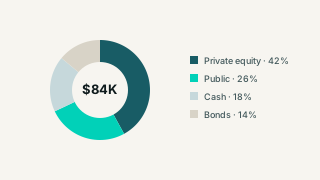
Diversification is one of the most fundamental principles in investing — the idea that spreading your capital across different asset types can reduce risk and improve long-term outcomes. While most investors diversify across public stocks, bonds, and perhaps real estate, few consider the role that private market investments can play in a well-balanced portfolio. Here's how private markets fit into a diversification strategy and how to approach the allocation thoughtfully.
Why Diversification Matters
Start investing in private companies today
Create your free account and explore investment opportunities on StartEngine.
The core insight behind diversification is simple: different investments perform differently at different times. When one asset class is declining, another may be stable or rising. By holding a mix of assets that don't move in perfect lockstep, you can reduce the volatility of your overall portfolio without necessarily sacrificing returns.
Harry Markowitz, who won the Nobel Prize in Economics for his work on portfolio theory, called diversification "the only free lunch in finance." The math supports this: a portfolio of uncorrelated or loosely correlated assets can achieve better risk-adjusted returns than any single asset class alone.
The Traditional Portfolio
A typical individual investor's portfolio might include:
- U.S. stocks (large-cap, mid-cap, small-cap)
- International stocks
- Bonds (government and corporate)
- Cash and cash equivalents
- Perhaps some real estate (through REITs or property ownership)
This is a solid foundation. But it leaves out an enormous segment of the investment universe: private markets. By focusing exclusively on publicly traded securities, investors miss exposure to the vast majority of companies and an entire return profile.
How Private Markets Add Diversification
Low Correlation with Public Markets
Private market returns don't perfectly mirror public market returns. While both are influenced by the broader economy, private companies — especially early-stage ones — are driven more by company-specific factors (product development, customer acquisition, fundraising) than by daily market sentiment.
This lower correlation means adding private investments to a portfolio of public stocks and bonds can reduce overall portfolio volatility. When the stock market drops 20%, your private investments don't immediately show the same decline (though they may eventually be affected if economic conditions worsen).
Exposure to Different Growth Drivers
Public markets are dominated by large, mature companies. Private markets offer exposure to companies at earlier stages of development — where growth rates can be significantly higher. These companies are often building new products, entering new markets, or disrupting existing industries in ways that large public companies are not.
Access to Different Sectors
Many of the most innovative companies in areas like deep tech, biotech, fintech, and clean energy remain private for years. By including private investments in your portfolio, you gain exposure to sectors and companies that simply aren't available on public exchanges.
The Illiquidity Premium
Academic research suggests that investors in illiquid assets can earn a premium — additional returns that compensate for the inability to sell quickly. By accepting the illiquidity of private investments, you may capture returns that liquid markets don't offer.
How Institutional Investors Use Private Markets
Large institutional investors have long understood the diversification benefits of private markets:
- Yale University's endowment allocates over 30% to venture capital and leveraged buyouts
- Major pension funds typically allocate 15% to 25% to private equity, private credit, and real estate
- Sovereign wealth funds are among the largest investors in private markets globally
These institutions have access to the best data and the most sophisticated portfolio analysis tools. Their significant and growing allocation to private markets reflects a deep, data-driven conviction that these investments improve portfolio outcomes.
Individual investors haven't traditionally had this option. But equity crowdfunding platforms like StartEngine have changed that, making it possible for anyone to build a diversified private market portfolio.
Building Your Private Market Allocation
Step 1: Determine Your Allocation
How much of your portfolio should be in private markets? There's no one-size-fits-all answer, but consider these guidelines:
- Conservative approach: 5% to 10% of investable assets
- Moderate approach: 10% to 20% of investable assets
- Aggressive approach: 20% to 30% of investable assets (for investors with high risk tolerance, long time horizons, and ample liquidity elsewhere)
The right allocation depends on your age, income, net worth, risk tolerance, and liquidity needs. Younger investors with stable incomes and long time horizons can generally afford a higher allocation.
Step 2: Diversify Within Private Markets
Just as you wouldn't put your entire stock portfolio into one company, don't concentrate your private market allocation in a single investment. Diversify across:
- Number of companies: Aim for at least 10 to 20 private investments. More is generally better.
- Industries: Spread across technology, healthcare, consumer, fintech, real estate, and other sectors.
- Stages: Mix early-stage companies (higher risk, higher potential return) with later-stage companies (lower risk, more moderate return potential).
- Geographies: If possible, diversify across different markets and regions.
Step 3: Invest Gradually
Don't deploy your entire private market allocation at once. Invest steadily over time — perhaps making a few investments per quarter. This approach provides "vintage year diversification," spreading your capital across different market environments and reducing the risk of investing everything at a market peak.
Step 4: Rebalance Periodically
As your private investments grow (or don't), your actual allocation may drift from your target. Periodically review your portfolio and adjust your future investment pace to maintain your desired allocation.
Practical Considerations
Liquidity Planning
Because private investments are illiquid, your portfolio planning must account for your cash needs. Ensure you have:
- An emergency fund (3 to 6 months of expenses) in cash or highly liquid investments
- Sufficient liquid investments (public stocks, bonds, savings) to cover near-term and medium-term financial goals
- Only then allocate surplus capital to private markets
Tax Considerations
Private investments may have different tax implications than public market investments. Capital gains treatment, holding periods, and loss deductions can vary. Consult with a tax professional to understand how private investments fit into your tax planning.
Record Keeping
With multiple private investments across different platforms, keeping organized records is important. Track:
- Investment dates and amounts
- Company name and security type
- Offering terms and documents
- Updates from portfolio companies
- Any exits or returns received
The Power of the Portfolio Approach
One of the most important concepts in private market investing is the portfolio approach. Individual private investments are inherently uncertain — any single company may fail. But a diversified portfolio of private investments can produce attractive aggregate returns.
Consider venture capital as an analogy: a typical VC fund invests in 20 to 30 companies, expecting that most will fail or return capital, a handful will do moderately well, and one or two will be breakout successes that generate the majority of the fund's returns. Individual investors can apply the same logic.
By building a portfolio of 15 to 20+ private investments across different sectors and stages, you increase the probability that your portfolio includes at least a few strong performers while limiting the impact of any single failure.
Conclusion
Private market investments offer genuine diversification benefits when added to a traditional portfolio of public stocks and bonds. They provide exposure to different growth drivers, lower correlation with public markets, and the potential for an illiquidity premium. Institutional investors have recognized these benefits for decades, and individual investors now have the tools to follow suit.
The keys to success are setting an appropriate allocation, diversifying broadly within private markets, investing gradually over time, and maintaining sufficient liquidity for your near-term needs. With this disciplined approach, private market investments can be a powerful complement to your existing portfolio and a meaningful contributor to your long-term wealth-building strategy.
Start investing in private companies today
Create your free account and explore investment opportunities on StartEngine.
Terms in this article
Important disclosure
Investing in private company securities is highly speculative and involves substantial risk. Educational content does not constitute investment advice. Past performance does not guarantee future results.