Selling & Secondary Markets · GUIDE
What Are Secondary Markets for Private Shares?
An overview of how secondary markets create liquidity for private company shareholders.
7 min read
Updated May 27th, 2026
When you invest in a private company, one of the first questions that comes to mind is: "How do I eventually get my money back?" Unlike public stocks, which you can sell in seconds through a brokerage app, private shares have historically been difficult to sell before a major event like an IPO or acquisition. Secondary markets are changing that. Here's what you need to know about how secondary markets work for private shares and why they're becoming an increasingly important part of the private market ecosystem.
Primary vs. Secondary Markets
To understand secondary markets, it helps to start with the distinction between primary and secondary transactions:
- Primary market: When a company sells new shares directly to investors to raise capital. This is what happens during a funding round or an equity crowdfunding offering. The money goes to the company.
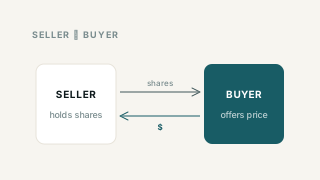
- Secondary market: When existing shareholders sell their shares to other investors. The company doesn't issue new shares and doesn't receive any money — the transaction is between the seller and the buyer.
In public markets, the secondary market is the stock exchange itself. After a company's IPO (the primary offering), all subsequent trading of those shares happens on the secondary market (NYSE, Nasdaq, etc.).
For private companies, there's no stock exchange. But a growing ecosystem of platforms and mechanisms is emerging to facilitate secondary transactions in private shares.
Why Secondary Markets Matter
For Shareholders (Sellers)
If you invested in a private company five years ago, you may have a legitimate need to access some of that capital — for a life event, to rebalance your portfolio, or simply because your circumstances have changed. Without a secondary market, you'd be stuck waiting for an exit event that may be years away (or may never come).
Secondary markets provide optionality. They give shareholders a potential pathway to liquidity without requiring the company to go public or be acquired.
For Investors (Buyers)
Secondary markets allow investors to buy shares in private companies that may no longer be raising capital through primary offerings. This can be attractive for investors who want exposure to more mature private companies that are closer to a potential exit event.
For Companies
While companies don't directly participate in most secondary transactions, a functioning secondary market can benefit them by making their equity more attractive. Employees may be more willing to accept equity compensation if they know there's a potential path to selling those shares. Investors may be more willing to invest in primary offerings if they know a secondary market exists.
How Private Secondary Markets Work
Platform-Based Marketplaces
The most structured approach to private share trading happens through dedicated platforms. These platforms connect sellers who want to offload private shares with buyers who want to acquire them. StartEngine's secondary market, for example, allows shareholders in certain companies to list their shares for sale to other investors on the platform.
The platform typically handles:
- Matching buyers and sellers
- Price discovery (through listed prices, bid/ask mechanisms, or negotiated transactions)
- Compliance and regulatory requirements
- Transfer of shares and funds
Direct (Peer-to-Peer) Transactions
Some secondary transactions happen directly between parties — for example, an employee selling shares to another individual. These transactions typically require:
- Agreement on price
- Company approval (most private companies have transfer restrictions)
- Legal documentation
- Compliance with securities regulations
Direct transactions can be complex and are often facilitated by attorneys or brokers.
Company-Sponsored Liquidity Programs
Some private companies periodically offer their shareholders the opportunity to sell shares back to the company or to new investors in a structured process. These "tender offers" or "buyback programs" are managed by the company and provide a controlled, company-approved path to liquidity.
Structured Secondary Funds
Some investment firms raise funds specifically to buy private company shares on the secondary market. These funds actively seek out shareholders interested in selling and may offer competitive prices for shares in high-demand companies.
The Mechanics of a Secondary Transaction
A typical secondary market transaction involves several steps:
- Listing or expression of interest: The seller indicates they want to sell shares, including the number of shares and their desired price.
- Buyer interest: A buyer indicates willingness to purchase at the listed price or makes a counter-offer.
- Price agreement: Buyer and seller agree on a price per share.
- Compliance checks: The platform or broker verifies that both parties meet regulatory requirements (accredited investor status, holding period compliance, etc.).
- Company approval: Most private companies have a right of first refusal (ROFR) or other transfer restrictions. The company must typically approve the transfer, which may involve matching the buyer's offer or waiving its right to purchase the shares.
- Transfer execution: Once approved, the shares are transferred from the seller to the buyer, and payment is processed.
- Cap table update: The company updates its capitalization table to reflect the new ownership.
Key Considerations
Pricing
Unlike public stocks with continuous market pricing, private share prices on secondary markets are determined through negotiation or limited market activity. Prices may be based on:
- The company's most recent valuation
- Supply and demand dynamics
- The company's financial performance and growth trajectory
- Broader market conditions
There's no guarantee that the price reflects the "true" value of the shares. Buyers should do their own due diligence, and sellers should have realistic expectations about achievable prices.
Transfer Restrictions
Most private companies impose restrictions on the transfer of shares. Common restrictions include:
- Right of first refusal (ROFR): The company has the right to purchase the shares before they can be sold to a third party
- Board approval: The company's board of directors must approve the transfer
- Holding periods: Securities regulations may require that shares be held for a minimum period before resale
- Qualified purchaser requirements: The buyer may need to meet certain criteria
Regulatory Requirements
Secondary transactions in private securities are regulated. Key considerations include:
- Securities sold under Reg CF generally have a one-year holding period before resale
- Reg A+ securities may be freely tradable
- Reg D securities are "restricted securities" and are subject to holding periods and resale limitations under Rule 144
- Both buyers and sellers must comply with applicable securities laws
Liquidity Is Not Guaranteed
Even with a secondary market, there's no guarantee that you'll find a buyer for your shares at a price you find acceptable — or at all. Secondary markets for private shares are less liquid than public stock exchanges, and activity varies significantly by company. High-demand companies may see active trading, while less well-known companies may see little to no secondary market activity.
The Growth of Private Secondary Markets
Private secondary markets have grown significantly in recent years, driven by several factors:
- Companies staying private longer: With companies like SpaceX and Stripe remaining private for extended periods, shareholder demand for liquidity has increased.
- Growth of equity crowdfunding: As more people invest in private companies through crowdfunding, demand for secondary liquidity options has grown.
- Technology: Digital platforms have made it easier to facilitate compliant secondary transactions at scale.
- Regulatory evolution: The SEC and industry participants continue to develop frameworks that support responsible secondary trading.
Platforms like StartEngine are at the forefront of this evolution, building secondary market infrastructure that gives investors more options for managing their private market portfolios.
Conclusion
Secondary markets for private shares are an important and growing component of the private market ecosystem. They provide shareholders with potential liquidity options and give new investors access to private companies outside of primary offerings.
While secondary markets don't offer the same liquidity as public stock exchanges, they represent a significant improvement over the historical reality of having no path to selling private shares before an IPO or acquisition. As these markets continue to mature, they will play an increasingly important role in making private market investing more practical and accessible for all investors.
Important disclosure
All content is for educational purposes only and does not constitute investment advice. All investments involve risk, including loss of principal. Please consult with a qualified financial advisor before making investment decisions.

