Fundamentals · GUIDE
Public vs. Private Markets: Key Differences
Understand the structural, regulatory, and practical differences between public and private market investing.
6 min read
Updated May 27th, 2026
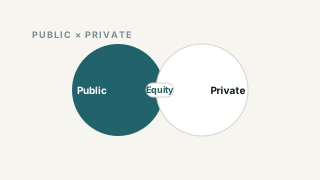
When most people think about investing, they think about the stock market — buying shares of Apple, Tesla, or an S&P 500 index fund through a brokerage account. But the stock market represents only a fraction of the total investment landscape. Private markets, where shares are not listed on public exchanges, represent an enormous and growing alternative. Understanding the differences between these two worlds is essential for any investor looking to build a well-rounded portfolio.
What Are Public Markets?
Public markets are exchanges where securities of publicly listed companies are bought and sold. The most well-known examples include the New York Stock Exchange (NYSE) and Nasdaq. When a company "goes public" through an IPO, its shares become available for anyone to purchase through a brokerage account.
Public markets are characterized by high liquidity, extensive regulation, mandatory financial disclosures, and real-time pricing. Millions of transactions happen every day, and the price of any given stock is continuously updated based on supply and demand.
What Are Private Markets?
Private markets encompass all investment transactions that occur outside of public exchanges. This includes venture capital, private equity, equity crowdfunding, private credit, and secondary transactions in private company shares. Companies in private markets have not conducted an IPO and their securities are not freely tradable on an exchange.
Private markets are characterized by limited liquidity, less frequent valuations, negotiated transactions, and a different regulatory framework than public markets.
Key Differences
1. Access and Eligibility
Public markets are open to virtually anyone. You can open a brokerage account online in minutes and start buying shares of publicly traded companies with no minimum investment requirement.
Private markets have historically been restricted to institutional investors and accredited individuals (those with a net worth exceeding $1 million or annual income above $200,000). However, regulatory changes — particularly Regulation Crowdfunding (Reg CF) and Regulation A+ — have opened private markets to all investors through platforms like StartEngine. Still, certain private offerings remain limited to accredited investors.
2. Liquidity
Public markets offer near-instant liquidity. You can sell your shares during market hours and receive cash in your account within days. This makes public markets attractive for investors who may need access to their capital.
Private markets are illiquid by nature. When you invest in a private company, there's typically no easy way to sell your shares. You may need to hold your investment for years — until a liquidity event like an IPO, acquisition, or secondary market sale occurs. This illiquidity is one of the most important factors to consider before investing in private markets.
3. Information and Transparency
Public companies are required by the SEC to file regular financial reports (10-K annual reports, 10-Q quarterly reports), disclose material events, and provide audited financial statements. Analysts, journalists, and the public can scrutinize this information.
Private companies have far fewer disclosure requirements. While companies raising capital under Reg CF or Reg A+ must file certain documents with the SEC, the depth and frequency of reporting is generally less than what public companies provide. Investors in private companies often have to make decisions with less information.
4. Pricing and Valuation
Public market prices are set continuously by the market through the interaction of buyers and sellers. You always know what your shares are worth — just check the current stock price.
Private market valuations are periodic and often subjective. A private company's valuation is typically set during fundraising rounds or through independent appraisals. Between these events, the true value of your investment is uncertain. This lack of real-time pricing can be a disadvantage, but it also means private investors aren't subject to the daily emotional swings of market volatility.
5. Regulation
Public markets are heavily regulated. The SEC, FINRA, and stock exchanges impose extensive rules on public companies, brokers, and market participants. These regulations are designed to protect investors and ensure fair, orderly markets.
Private markets are regulated too, but under different frameworks. Private offerings typically rely on exemptions from full SEC registration — such as Regulation D, Regulation A+, or Regulation CF. Each exemption comes with its own rules about who can invest, how much can be raised, and what disclosures are required. Platforms that facilitate private offerings, like StartEngine, must be registered with the SEC and FINRA.
6. Investment Minimums
Public markets have essentially no minimum investment. You can buy fractional shares of most stocks for just a few dollars.
Private markets vary widely. Traditional private equity and venture capital funds often require minimum investments of $250,000 or more. However, equity crowdfunding has dramatically lowered these minimums — some offerings on crowdfunding platforms accept investments as low as $100.
7. Return Profiles
Public markets offer returns primarily through stock price appreciation and dividends. Historical average annual returns for the S&P 500 have been around 10% (before inflation). Returns are visible in real-time and can be volatile in the short term.
Private markets can offer higher return potential, particularly for early-stage investments in companies that go on to achieve significant growth. However, the range of outcomes is much wider — many private investments may result in partial or total loss of capital, while others may generate returns many times the original investment. Returns are realized only upon a liquidity event.
8. Time Horizon
Public market investments can be held for any duration — seconds, days, or decades. There are no restrictions on when you can buy or sell.
Private market investments typically require a multi-year commitment. Depending on the company and the type of offering, you may be unable to sell your shares for three to ten years or more. This makes private market investing more suitable for capital you won't need in the near term.
9. Volatility
Public markets experience daily price fluctuations driven by earnings reports, economic data, geopolitical events, and market sentiment. This volatility can create anxiety for investors, particularly during market downturns.
Private markets don't display daily price changes, which can reduce the psychological pressure of investing. However, this doesn't mean private investments are less risky — it simply means the volatility isn't visible. The underlying business risks remain.
The Convergence of Public and Private Markets
The line between public and private markets is increasingly blurred. Several trends are driving this convergence:
- Companies are staying private longer. The average age of a company at IPO has increased significantly, meaning more value creation happens in the private phase.
- Regulatory reforms like the JOBS Act have made private investments accessible to retail investors for the first time.
- Secondary markets for private shares are growing, providing more liquidity options that make private markets function more like public ones.
- Technology platforms are making it easier to discover, invest in, and manage private market investments alongside public holdings.
Which Is Right for You?
The answer isn't either/or — it's both. A thoughtful investment strategy may include a core allocation to public markets for liquidity, diversification, and stability, supplemented by private market investments for growth potential and exposure to innovative companies.
The right mix depends on your financial goals, risk tolerance, time horizon, and liquidity needs. As a general principle, only invest in private markets with capital you can afford to have locked up for several years.
Conclusion
Public and private markets each offer distinct advantages and challenges. Public markets provide liquidity, transparency, and ease of access. Private markets offer the potential for higher returns, exposure to early-stage companies, and portfolio diversification — but require patience, due diligence, and a tolerance for illiquidity.
Understanding these differences is the foundation of making informed investment decisions. As private markets continue to become more accessible through platforms and regulatory innovation, investors who understand both worlds will be best positioned to take advantage of the full spectrum of opportunities available.
Important disclosure
All content is for educational purposes only and does not constitute investment advice. All investments involve risk, including loss of principal. Please consult with a qualified financial advisor before making investment decisions.

