· GUIDE
Risks of Private Market Investing (And How to Manage Them)
An honest look at the risks involved and strategies for managing them effectively.
7 min read
Updated June 5th, 2026
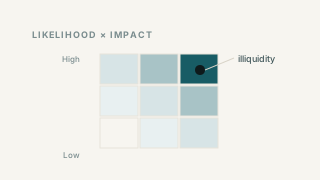
Every investment carries risk, and private market investments are no exception. In fact, private investments come with a unique set of risks that differ from those of public stocks and bonds. Understanding these risks — and knowing how to manage them — is essential for anyone considering private market investing. This isn't meant to discourage you, but to help you make informed decisions with clear eyes.
The Core Risks
Start investing in private companies today
Create your free account and explore investment opportunities on StartEngine.
1. Illiquidity Risk
What it is: When you invest in a private company, you generally cannot sell your shares on demand. There's no stock exchange with continuous trading. Your capital may be locked up for years.
Why it matters: If you need the money for an emergency or another opportunity, you may not be able to access it. Even if a secondary market exists, there's no guarantee of finding a buyer at a price you find acceptable.
How to manage it: Only invest capital you can afford to have tied up for five to ten years or more. Keep a sufficient emergency fund and liquid investments before allocating to private markets. As secondary markets for private shares grow — through platforms like StartEngine and others — liquidity options are improving, but they should not be relied upon.
2. Total Loss of Capital
What it is: Private companies, especially early-stage startups, have a high failure rate. If a company goes out of business, your investment may be worth nothing.
Why it matters: Unlike large public companies that may decline gradually, private companies can fail abruptly. There may be no recovery of capital.
How to manage it: Diversify across multiple investments. The venture capital model works on the principle that most investments will fail or underperform, but a small number of big winners can drive overall portfolio returns. Aim to build a portfolio of at least 10 to 20 private investments rather than concentrating in one or two.
3. Information Asymmetry
What it is: Private companies provide far less information than public companies. You're making investment decisions with incomplete data, and the company's management team always knows more about the business than you do.
Why it matters: Limited information makes it harder to assess the true state of the business, identify problems early, or make informed decisions about holding or selling.
How to manage it: Read all available offering documents carefully. Research the industry and competitors independently. Pay attention to companies that provide regular investor updates. Use platforms that require meaningful disclosures and facilitate investor communication.
4. Dilution Risk
What it is: When a company raises additional capital by issuing new shares, existing shareholders' ownership percentage decreases. This is called dilution.
Why it matters: Even if a company is doing well and growing, if it raises many additional rounds of funding, your percentage of ownership may shrink significantly. In extreme cases, aggressive dilution can erode the value of your investment even as the company grows.
How to manage it: Understand the company's expected future fundraising needs. Companies that need to raise many more rounds before reaching profitability or an exit will dilute existing shareholders more. Look at the terms of your investment — some securities include anti-dilution protections.
5. Valuation Risk
What it is: The valuation at which you invest may not reflect the company's true worth. Private valuations are subjective and can be influenced by market hype, negotiating dynamics, or overly optimistic assumptions.
Why it matters: If you invest at an inflated valuation, even a successful company may not generate attractive returns for you. Conversely, if the company raises a future round at a lower valuation (a "down round"), the value of your investment declines on paper.
How to manage it: Evaluate valuations critically. Compare to peers, examine the underlying financials, and be skeptical of companies with very high valuations relative to their revenue, stage, or traction. Don't invest just because a company is popular.
6. Regulatory and Legal Risk
What it is: Changes in laws, regulations, or regulatory interpretation can affect private investments. Companies may also face legal issues — lawsuits, intellectual property disputes, compliance failures — that damage their value.
Why it matters: Regulatory changes could alter the landscape for the company's products or services. Legal issues can be expensive, distracting, and potentially fatal for small companies.
How to manage it: Review the risk factors disclosed in offering documents. Understand the regulatory environment the company operates in. Diversification helps here too — regulatory risk that affects one company or industry may not affect others.
7. Market and Economic Risk
What it is: Broader economic conditions — recessions, interest rate changes, market downturns — can negatively affect private companies. Economic stress can reduce consumer spending, make fundraising harder, and delay exits.
Why it matters: Even well-run companies can struggle in a poor economic environment. If the IPO market dries up or acquisition activity slows, your path to a return may be delayed or eliminated.
How to manage it: Maintain a diversified overall portfolio that includes liquid, lower-risk investments alongside your private market allocation. Don't over-allocate to private markets at the expense of financial stability.
8. Management Risk
What it is: The success of a private company is heavily dependent on its management team. Poor decisions, loss of key personnel, or mismanagement can destroy value.
Why it matters: In early-stage companies, the CEO and founding team are often irreplaceable. A key departure or a series of bad strategic decisions can derail an otherwise promising company.
How to manage it: Evaluate the team carefully before investing. Look for relevant experience, a track record of execution, and demonstrated commitment. Pay attention to how management communicates with investors — transparency is a positive signal.
9. Fraud Risk
What it is: While rare, fraud does occur in private markets. Companies may misrepresent their financials, traction, or business prospects.
Why it matters: Fraud can result in total loss of your investment.
How to manage it: Invest through regulated platforms that conduct due diligence on offerings. The SEC requires companies raising capital through Reg CF, Reg A+, and Reg D to make certain disclosures. Be skeptical of claims that seem too good to be true. Verify key claims independently when possible.
Building a Risk Management Strategy
Managing risk in private markets isn't about avoiding risk — it's about taking smart, informed risks. Here's a practical approach:
Set an Allocation Limit
Decide in advance what percentage of your total investment portfolio you'll allocate to private investments. For most individual investors, financial advisors suggest keeping this between 5% and 15% of investable assets, depending on your risk tolerance and financial situation.
Diversify Broadly
Spread your private market allocation across:
- Multiple companies (aim for 10 or more)
- Multiple industries (don't concentrate in one sector)
- Multiple stages (mix early-stage and later-stage companies)
- Multiple offering types (Reg CF, Reg A+, secondary market purchases)
Invest Consistently
Rather than making one large investment, consider investing smaller amounts across multiple opportunities over time. This dollar-cost averaging approach reduces the risk of making a single bad timing decision.
Stay Informed
Follow your portfolio companies. Read their updates. Pay attention to the private market landscape. Informed investors make better decisions about when to hold and when to seek an exit.
Know Your Exit Options
Before investing, understand how you might eventually get a return. Common exit paths include IPOs, acquisitions, secondary market sales, and dividend distributions. A company with no plausible exit path is a riskier investment.
Conclusion
Private market investing offers compelling potential rewards, but those rewards come with real risks. The most successful private market investors aren't those who avoid risk — they're those who understand it, respect it, and manage it systematically.
By diversifying broadly, investing within your means, conducting thorough due diligence, and maintaining realistic expectations, you can participate in the potential upside of private markets while protecting yourself against the downside. The goal isn't to eliminate risk — it's to ensure that the risks you take are deliberate, informed, and proportionate to your overall financial plan.
Start investing in private companies today
Create your free account and explore investment opportunities on StartEngine.
Terms in this article
Important disclosure
Investing in private company securities is highly speculative and involves substantial risk. Educational content does not constitute investment advice. Past performance does not guarantee future results.