Investing in Private Companies · GUIDE
Understanding Private Company Valuations
Learn how private companies are valued and what those numbers mean for investors.
6 min read
Updated May 27th, 2026
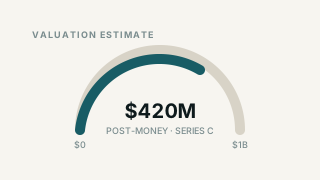
Valuation is one of the most important — and most misunderstood — concepts in private market investing. When a company raises money or when you consider buying shares on a secondary market, the valuation determines how much of the company you're getting for your money. Unlike public companies, where the market sets the price every second, private company valuations are the result of negotiation, methodology, and judgment. Here's what investors need to know.
What Is a Valuation?
A company's valuation is an estimate of its total worth. When we say a private company has a "$50 million valuation," we mean that the company's equity is estimated to be worth $50 million in total. If you invest $50,000 at that valuation, you're purchasing approximately 0.1% ownership of the company.
Two key terms to understand:
- Pre-money valuation: The company's estimated value before the current round of funding is added.
- Post-money valuation: The company's estimated value after the new investment is included. Post-money = Pre-money + New Investment.
For example, if a company has a $10 million pre-money valuation and raises $2 million, the post-money valuation is $12 million. An investor who contributed the entire $2 million would own approximately 16.7% of the company ($2M / $12M).
Why Valuations Matter
The valuation at which you invest directly determines:
- Your ownership stake: A lower valuation means you get more of the company for your money.
- Your potential return: If the company's value increases from when you invested to when you exit, you profit. The lower your entry valuation, the greater your potential return (all else being equal).
- Dilution impact: Future rounds at higher valuations are less dilutive. Future rounds at lower valuations ("down rounds") are more dilutive and can significantly erode your ownership.
Understanding valuation helps you assess whether an investment offers reasonable potential upside relative to the risks involved.
How Private Companies Are Valued
There is no single "correct" way to value a private company. Different methods are appropriate at different stages, and valuations always involve assumptions and judgment.
1. Revenue Multiples
One of the most common approaches for companies with revenue. The company's annual revenue (or projected revenue) is multiplied by a factor that reflects the industry, growth rate, and market conditions.
Example: A SaaS company generating $2 million in annual recurring revenue might be valued at 10x revenue, yielding a $20 million valuation. The multiple varies widely — high-growth technology companies may command 15x to 30x or more, while traditional businesses might be valued at 2x to 5x.
Key considerations:
- What revenue metric is being used (total revenue, recurring revenue, gross profit)?
- Is the growth rate high enough to justify the multiple?
- How does the multiple compare to similar companies?
2. Comparable Company Analysis
This method looks at valuations of similar companies — either recent private funding rounds or publicly traded peers — to establish a benchmark.
Example: If three comparable SaaS companies recently raised funding at 12x to 15x revenue, a similar company might reasonably be valued in that range.
Key considerations:
- Are the "comparable" companies truly comparable in terms of stage, growth, market, and business model?
- Market conditions affect comparables — multiples expand in bull markets and contract in downturns.
3. Discounted Cash Flow (DCF)
This method projects the company's future cash flows and discounts them back to their present value. It's more commonly used for later-stage companies with predictable revenue streams.
Key considerations:
- DCF requires assumptions about future growth, margins, and discount rates — small changes in these assumptions can dramatically change the output.
- It's less useful for early-stage companies with little or no revenue.
4. Cost-to-Duplicate
This approach estimates what it would cost to build the company from scratch — including developing the technology, hiring the team, and acquiring the customers. It's sometimes used for very early-stage companies.
Key considerations:
- This method often undervalues companies because it doesn't account for intangibles like brand, relationships, and momentum.
5. Scorecard / Berkus Method
Used primarily for pre-revenue startups, these methods assign value based on qualitative factors like team strength, market size, product stage, and competitive advantage. The Berkus Method, for example, assigns up to $500,000 of value for each of several key factors.
Key considerations:
- These methods are highly subjective and are best used as rough guides rather than precise valuations.
6. Last Round Valuation
The simplest reference point: what valuation did the company achieve in its last fundraising round? This is often used as a starting point in secondary market transactions.
Key considerations:
- The last round may have included preferential terms (liquidation preferences, anti-dilution provisions) that inflate the headline valuation.
- Market conditions may have changed since the last round.
- Time elapsed matters — a round from three years ago may not reflect current value.
Factors That Influence Valuation
Beyond the methodology, several factors affect how a private company is valued:
- Growth rate: Faster-growing companies command higher valuations.
- Market size: Companies targeting large markets have more room to grow.
- Team quality: Experienced, proven teams are valued more highly.
- Competitive position: Market leaders and companies with defensible moats are worth more.
- Stage: Later-stage companies with proven business models are valued more than early-stage companies with unproven concepts.
- Market conditions: Bull markets push valuations up; bear markets push them down.
- Investor demand: Popular offerings may achieve higher valuations due to demand.
Common Pitfalls
Anchoring on Headline Valuations
A "$100 million valuation" sounds impressive, but it's meaningless without context. Is the company generating revenue? Growing? Profitable? A high valuation isn't automatically good — it means you need more growth to generate a return.
Ignoring the Terms
Two companies with the same headline valuation can offer very different deals. Pay attention to:
- The type of security (common stock vs. preferred stock vs. SAFEs)
- Liquidation preferences
- Anti-dilution provisions
- Valuation caps (for convertible instruments)
Assuming Linear Growth
Companies don't grow in straight lines. A valuation based on optimistic growth projections may not hold up if growth slows or the market shifts.
Overlooking Dilution
If a company is going to raise several more rounds of funding before an exit, your ownership percentage will decrease. Factor future dilution into your return expectations.
Valuations in Equity Crowdfunding
On platforms like StartEngine, companies set their own valuation when they create an offering. As an investor, you should:
- Compare to peers: Look at similar companies at similar stages and see what valuations they've achieved.
- Evaluate the fundamentals: Does the valuation make sense given the company's revenue, growth, team, and market?
- Consider the upside: If the company executes well, is there enough room for the valuation to increase meaningfully from where it is today?
- Read the terms carefully: Understand what you're actually getting for your investment.
Conclusion
Private company valuations are part art, part science. They involve methodology, negotiation, and judgment — and reasonable people can disagree about what a company is worth. As an investor, your goal isn't to determine a precise value but to assess whether the valuation is reasonable enough to offer attractive potential returns given the risks.
Focus on understanding the methods used, comparing to benchmarks, and evaluating the underlying business fundamentals. A disciplined approach to valuation analysis — combined with diversification across multiple investments — is one of the best ways to build a successful private market portfolio.
Important disclosure
All content is for educational purposes only and does not constitute investment advice. All investments involve risk, including loss of principal. Please consult with a qualified financial advisor before making investment decisions.

